Agung
Three large hanging gongs that reinforce the rhythmic and sonic structure of the Tagunggu’ ensemble.
The agung produces a firm, authoritative low-frequency sound. In performance, it marks time, helps control tempo, and maintains musical continuity. (Cikgu Rosley’s research)
For the Bajau community, the agung forms part of langkapan—ancestral heirlooms with significant symbolic and spiritual value. (Cikgu Rosley’s research)
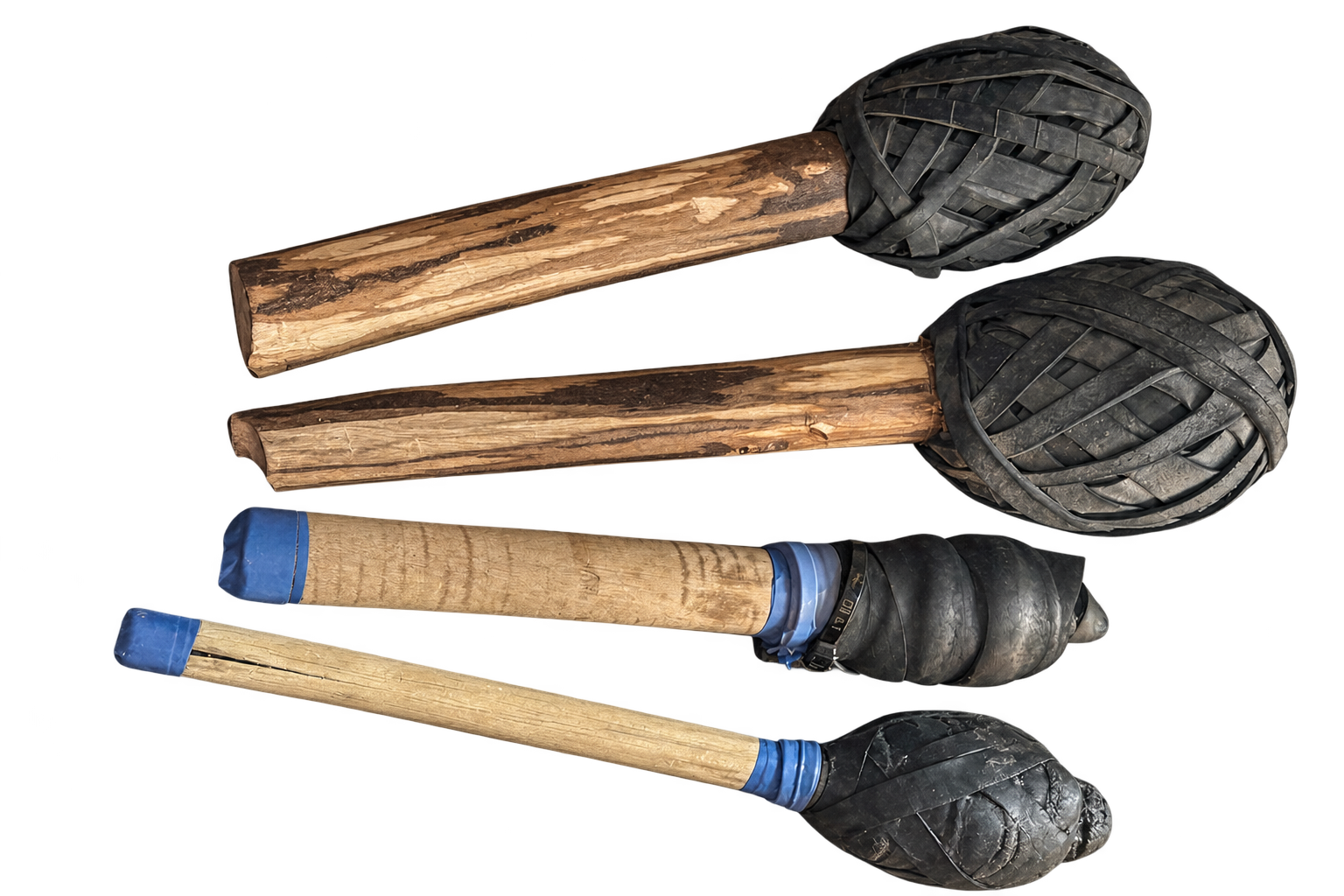
The wooden agung beater is known as tigung. (Cikgu Rosley’s research)
View tigung photo
Agung gongs were traditionally made from brass, with iron also used today. (TitikLab founder)
Classification and functions of the three agung
The smaller agung is known as agung sambut, the larger agung as agung lusung, and the flatter agung as agung bua. Each of the three has its own function. (Cikgu Rosley’s research)
- Agung bua, also known as canang or bell, completes and strengthens the musical flow (sulimbag) or the arrangement of the Tagunggu' musical rhythm. This function depends on the player’s skill. (SJ founder)
- Agung sambut is also known as agung tawag-tawag. Its name comes from the Suluk word tawag, meaning “to call”. It functions as a signal and is usually played rapidly. In the past, its strokes were used to summon the community or signal an emergency such as a death. (SJ founder)
- Agung lusung responds to or answers the musical flow (sulimbag). Agung sambut and agung lusung complement one another’s sound.
Hear each gong
Three agung sounds
From the left: the round, flatter agung bua; the agung lusung with a similar diameter but deeper profile; and the smallest agung sambut or agung tawag-tawag on the right. Press each gong to hear its recording.